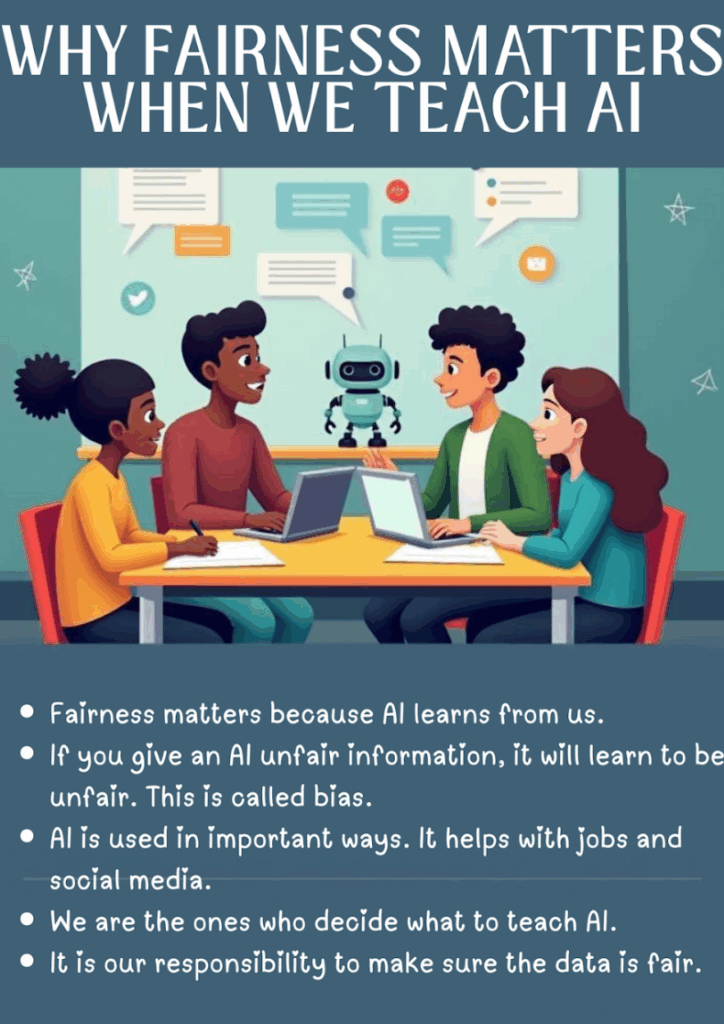
Should AI grade essays? Can it be biased? This interactive 6–8 lesson challenges students to think critically about AI responsibility. Through debates, role-plays, and creative projects, learners explore fairness, ethics, and the power of responsible decision-making in our digital world.
6th - 8th Grade
AI and Responsibility
Notes & Preparation
Project Length: 1 class period
Instructor Note:
This lesson centers on helping students understand their responsibility when using and designing AI.
Guide them to recognize bias, debate ethical scenarios, and express responsible practices through discussion, journaling, and poster creation
Standards
State Standards: AL, AZ, CA, CO, IN, MA, NY, OR, SD, WA, WY ISTE Standards: #2 Digital Citizen, #3 Knowledge Constructor, #6 Creative Communicator NET Standards: #1, #2, #6 Learning Objectives #1-4, #8, #9, #11, #13, #21, #25, #26, #27, #32, #37, #38, #41, #42 CS Standards: Bias and responsible computing
Engage
Opening:Begin with a debate prompt such as, “Should AI grade student essays?” to spark interest and surface prior knowledge.
Opening Debate Prompt:
Have students physically move to one side of the room to “agree” or “disagree” with the statement. Ask a few students from each side to explain their reasoning. This sparks debate and surfaces their prior knowledge about AI’s capabilities and limitations.
Computer Introduction:Review what a computer does (follows instructions), what intelligence means (learning, problem-solving), and how AI combines the two to make decisions.
Project Description: Explain the lesson’s goal: Students will explore scenarios where AI is used responsibly and irresponsibly, examine bias through an activity, and create a poster to advocate for fair and responsible AI use.
Explore
Scenario Role-Plays: In small groups, act out responsible vs. irresponsible AI decisions (homework, hiring, policing, recommendations).
Code.org AI for Oceans Bias Activity: Compare results of training AI with fair vs. unfair data.
Bias: When data is incomplete or unfair, AI decisions are biased.
Ethics: Considering what’s fair or unfair.
Responsibility: Humans decide how AI is used.
Key Point: AI reflects human choices; it’s our responsibility to ensure fairness.
Learning Outcomes
Students will:
Students will recognize bias in AI training.
Students will debate ethical dilemmas in AI use.
Students will commit to responsible AI practices.
Students will create persuasive posters advocating for fairness and responsibility in AI
Project
Have the student:
Journal Reflection (5 min)
Have students spend a few minutes writing a reflection in a class journal or on a shared document, answering the question: “Why does fairness matter when we are teaching AI?”
Class Discussion (10 min): As a class, develop a School AI Responsibility Pledge. Have students contribute ideas for a simple, clear pledge that everyone can agree to.
Project Creation (25 min): In pairs or small groups, students will create an artifact to promote responsible AI. Give them the choice of one of the following options:
AI Responsibility Poster:
Instructions: Using a digital tool like Canva or physical art supplies, have each group design a poster.
Title/Slogan: A catchy slogan about AI and responsibility (e.g., “AI is Fair, if we are Aware”).
Short Message: A brief, persuasive message about fairness and responsibility in AI.
Visuals: Use images and graphics to make the message clear and compelling.
AI PSA (Public Service Announcement) Video:
Instructions: Students will create a short video (30-60 seconds) that educates their peers on AI responsibility.
Content: The video should include a clear slogan, a scenario, and a call to action.
AI Ethics Infographic:
Instructions: Students will create a visual representation of a real-world example of AI bias.
Content: The infographic should explain the problem and a proposed solution using data and clear visuals.
AI Responsibility Board Game:
Instructions: Students will design a board game that teaches fair data and responsible AI.
Content: They must create game rules, design the board, and write “chance” cards that present ethical dilemmas
Evaluate
After class, note:
Formative: Observe students’ participation in the debates and role-plays, and their contributions to the class pledge.
Summative:
AI Responsibility Journal: Review student reflections to assess their understanding of fairness in AI.
Class AI Responsibility Pledge: Evaluate the collaborative nature of the final pledge.
Canva Posters: Assess student understanding of responsible AI by the clarity of their message and the persuasive nature of their work.
Success Criteria: Students can define bias in AI, articulate responsible AI use, and create persuasive artifacts to promote fairness.
Elaborate
Research: Have advanced students research real-world examples of biased AI (e.g., facial recognition, social media algorithms).
Cross-Curricular: Connect the lesson to ELA (persuasive writing) and Social Studies (technology, justice, and civic responsibility).
Career Exploration: Explore careers in AI ethics, law, and data science